
The key to ignition interlock installation in the United States is this: the device follows the same basic process, but state rules determine who must install one and under what conditions. Before the car starts, you provide a breath sample; the device typically requires a reading below .02 BrAC and can block the starter when the reading is over its preset limit. After you drive away, it may request additional breath samples, but it can’t switch off a vehicle that’s already running. Every state and the District of Columbia allow interlocks for some DWI offenders, while requirements vary by offense and jurisdiction. That difference can make the next step feel unclear, especially when you need to keep driving while meeting a court or licensing requirement. This guide explains what an interlock does, how installation works, what’s known about its effectiveness, and how state rules differ, so you can understand the process and move forward with more clarity.
Key Takeaways
- Learn how a breath sample controls starting the vehicle and why the device may ask for additional samples during a trip.
- See what research says about interlocks and repeat impaired-driving offenses, including why results can differ after the device is removed.
- Understand how requirements vary by state, offense, and driver circumstances so you can identify the rules that may apply to you.
- Find out how Ignition Interlock Alliance’s free matching service can connect you with an Intoxalock provider for your state.
What Is An Ignition Interlock Device?
An ignition interlock connects to a vehicle’s starter system and uses a breath test before startup. The required reading is typically below .02 BrAC.
Its exact use depends on the device and program rules. The distinction between blocking a start and stopping a moving vehicle matters for everyday driving.
Breath Testing and Vehicle Starting
An ignition interlock device checks your breath for alcohol before allowing the vehicle to start. If the sample exceeds its preset limit, the device can prevent the starter from engaging.
After the vehicle starts, the device may request a random retest while you’re driving. You’ll have a few minutes to pull over safely before providing the sample. The interlock connects to the starter system, not the engine, so it cannot stop a vehicle that’s already running.
Vehicle Compatibility and Installation
Compatibility depends on the vehicle’s electrical system, make, model, and existing equipment. Most modern vehicles use a 12-volt electrical system, which interlocks typically require.
Electric and hybrid vehicles still need an installation assessment for their specific electrical setup. Many newer Tesla models from 2022 onward operate on a 16-volt system, so the installer must account for that difference. Older vehicles need electrical components in good working order. Existing remote-start capability must be disabled for installation, and the interlock draws some battery power while the engine is off.
Calibration, Monitoring, and Service
Calibration and monitoring appointments keep the device maintained and provide program records. At each service visit, the installer checks and calibrates the device. Follow the schedule assigned to your program.
When comparing providers, consider appointment access, customer support, and quoted service terms, and confirm that the option meets your state program’s requirements. If a test result seems wrong or the device malfunctions, note what happened and contact the provider promptly. Missing a required appointment can affect program compliance, so act quickly if you can’t attend.
When your requirement ends, follow the program’s process for release and removal. The device stays installed until removal is arranged, so don’t assume it will be disconnected automatically on the end date.
Effectiveness in reducing repeat drunk driving
Ignition interlocks can reduce repeat impaired driving while installed. A review of 15 studies found that DWI offenders with interlocks had arrest recidivism rates 75% lower than drivers without them. A separate meta-analysis found a 67% reduction in repeat drunk-driving offenses. These findings measure related outcomes, but they are not interchangeable: an arrest rate tracks arrests, while recidivism can describe repeat offenses more broadly.
An interlock limits one specific opportunity to drive after drinking. Before starting the vehicle, the driver must provide a breath sample within the device’s preset limit. If alcohol is detected above that limit, the device can prevent the vehicle from starting. It cannot prevent every impaired-driving attempt or address drinking choices away from the vehicle.
Timing matters, too. Interlocks reduce recidivism and alcohol-related crashes while installed, creating an immediate barrier during the restriction period. That protection ends when the device is removed. A Florida study found that offenders who received treatment alongside an interlock had one-third lower DWI recidivism after removal than offenders who had an interlock only. This highlights how additional support can matter beyond device use.
Broader policy findings offer another measure. According to the Insurance Institute for Highway Safety, laws mandating interlocks for all convicted drunk drivers reduce drunk-driving deaths by 26%. That finding concerns a law’s overall effect, not the outcome for any single driver. An interlock is one prevention tool, rather than a replacement for safe driving decisions or other support.
Your license and driving privileges remain subject to the terms of your state program. Follow the required device schedule and any additional program conditions throughout the assigned period. For a practical next step, review state-specific interlock options and how an installation connection can fit your requirements.
State ignition-interlock requirements
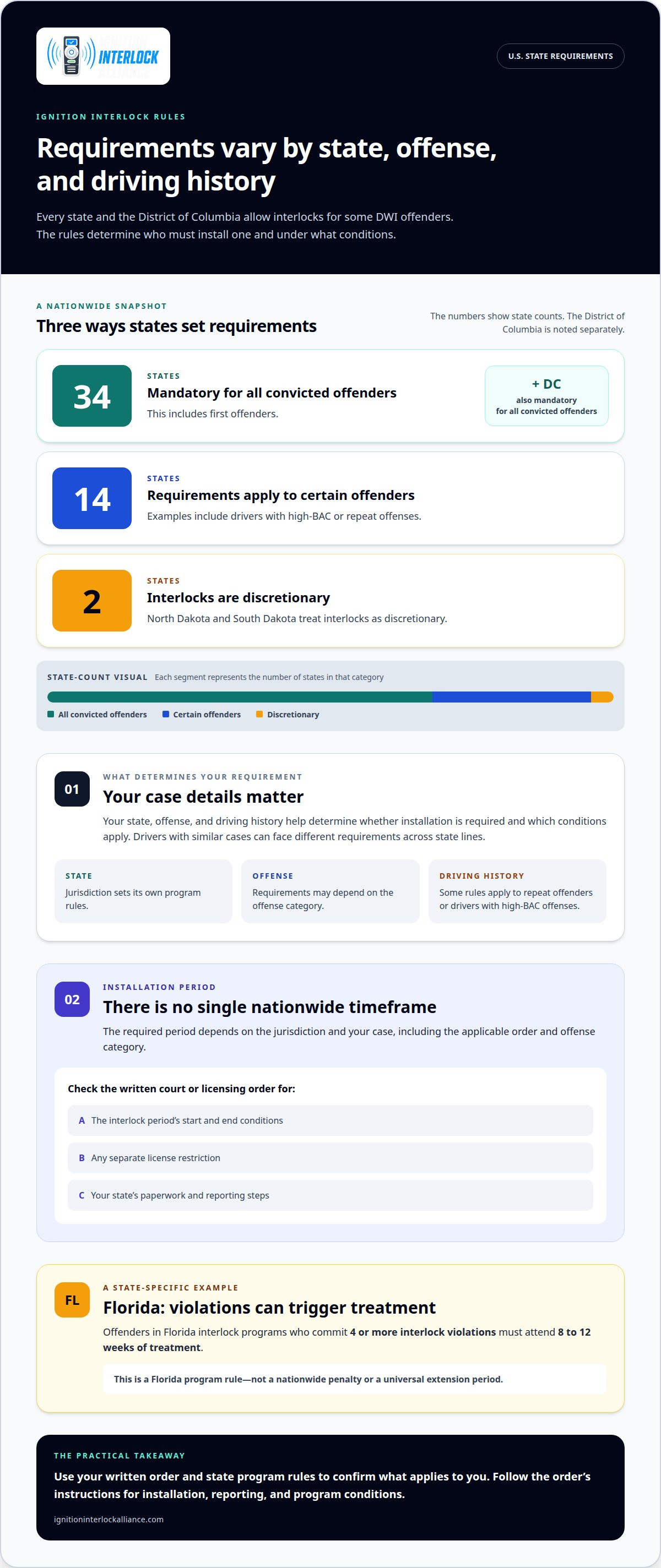
Ignition-interlock rules vary across the United States, although every state and the District of Columbia allow interlocks for some DWI offenders. Your state, offense, and driving history determine whether installation is required and which conditions apply.
In 34 U.S. states and the District of Columbia, interlocks are mandatory for all convicted offenders, including first offenders. In 14 states, requirements apply to certain offenders, such as drivers with high-BAC or repeat offenses. North Dakota and South Dakota treat interlocks as discretionary. These differences mean two drivers with similar cases can face different requirements across state lines.
There is no single nationwide answer for how long an interlock must stay installed. The required period depends on the jurisdiction and the driver’s case, including the applicable order and offense category. Check the written requirement for its start and end conditions, and distinguish the interlock period from any separate license restriction.
Violations and failed tests are handled under program rules, which differ by state. Florida provides a specific example: offenders in interlock programs who commit four or more interlock violations must attend 8 to 12 weeks of treatment. That rule requires treatment; it does not establish a nationwide penalty or a universal extension period.
To arrange installation, start with the written court or licensing order explaining the requirement. Your state’s program sets the paperwork and reporting steps, so follow the order’s instructions. Keep it accessible and note any agency, device condition, deadline, or reporting instruction it specifies.
Some requirements also address which vehicles need an interlock. Following a motorcycle-related DUI, the stated rule requires an IID in every vehicle the person owns or operates, including the motorcycle. Check the wording of your order for the vehicles it covers. Across all 50 states and the District of Columbia, the practical next step is to follow the rule for your jurisdiction, not assume another state’s process applies.
How do I find a state-approved ignition interlock provider and installer near me?
Use your state’s ignition-interlock program information to find providers approved for that program. A nearby automotive shop is not automatically an approved IID installer. For ignition interlock installation in the United States, the key is whether the provider’s device and installation process meet program requirements, not simply how close the location is.
Distinguish the provider from the installation location. A provider connects you with a device and its program process, while an installer fits the device in your vehicle. Before booking, confirm which location performs the installation and whether it works with your regular travel. This helps you plan around an actual installation site rather than a company’s general service area.
- Approval: Look for the provider through information tied to your state’s interlock program.
- Installation location: Identify the specific site where the device will be installed.
- Appointment planning: Confirm the available appointment process and what you need to bring.
- Ongoing logistics: Consider how you will reach the location for any required follow-up visits.
Keep the process within your program’s approved pathway. A general search may show businesses that work on vehicles, but that alone doesn’t mean they handle interlock installations accepted by your program. Ignition interlock installation in the United States requires both an eligible provider and a practical installation location.
If you want help making that connection, use the provider matching service to explore an Intoxalock option. Share your preferred installation area and appointment needs, then use the resulting connection to plan your next step.
Ignition Interlock Alliance
Ignition Interlock Alliance offers free matching to connect you with an Intoxalock provider when you’re ready to arrange installation. After you identify the requirements that apply to you, the service can help make the provider connection.
As an authorized Intoxalock agent and independent referral service, Ignition Interlock Alliance can help you move from understanding the process to finding an installation connection. The referral service is compensated by Intoxalock, not by consumers, so you can understand how the matching service is funded.
Ready to take the next step toward an Intoxalock match? Contact Ignition Interlock Alliance.
Take the Next Step With Confidence
For ignition interlock installation in the United States, your next step is finding a provider connection that fits your situation. Take it one decision at a time, starting with the requirements that apply to you.
Ignition Interlock Alliance’s work matching drivers with Intoxalock gives its team practical familiarity with the provider-connection process. Its free matching service can help you take the next step when you’re ready.
Contact Ignition Interlock Alliance to explore a match. You can move forward at your own pace.
Frequently Asked Questions
Can You Install an IID on an Electric or Hybrid Vehicle?
Installation depends on the vehicle’s electrical system and design. Most modern vehicles use a 12-volt system, which interlocks typically require. Many newer Tesla models from 2022 onward use a 16-volt system, so that difference matters when planning installation. Share the vehicle’s make, model, and year when arranging an appointment, especially if it’s electric or hybrid.
Can You Install an Interlock on Any Car?
Vehicle compatibility depends on the electrical setup, and older cars need electrical components in good working order. Installation also requires disabling existing remote-start capability. A car with remote start or unusual electrical equipment, for example, may need additional installation planning. Share the make, model, and year to help assess compatibility.
Can an IID Damage My Vehicle?
An IID connects to the vehicle’s starter system, not its engine, and cannot stop the vehicle once it’s running. It draws some power while the engine is off, so infrequent driving can contribute to battery drain. If your vehicle is older or has electrical issues, these factors matter for installation and everyday use. Tell the installer about any known battery or electrical problems.
What Is an Ignition Interlock Device and How Does It Work?
An ignition interlock device checks a driver’s breath before allowing a vehicle to start. Alcohol ignition interlocks generally require a reading below .02 BrAC. If a sample exceeds the preset limit, the device can block startup. Some devices also request breath samples during a trip. These running retests are designed to give the driver time to pull over safely.
Who Is Required to Install an Ignition Interlock Device in the United States?
It depends on the state and the driver’s offense. In 34 U.S. states and the District of Columbia, interlocks are mandatory for all convicted offenders, including first offenders. In 14 states, the requirement applies to certain offenders, such as high-BAC or repeat offenders. Your court or licensing order identifies the condition that applies to your case.
What Are the State-by-State Ignition Interlock Laws and Eligibility Rules?
Every U.S. jurisdiction has an ignition interlock law of some kind, and all 50 states and the District of Columbia allow interlocks for some DWI offenders. Requirements can be mandatory or discretionary and may depend on offense type. North Dakota and South Dakota treat interlocks as discretionary. Read your order for the rule that applies to your case, rather than relying on another state’s requirements.
